Agents Theorem
Agents' work is a continuous cycle of: Thought -> Action and Observing.
- Thought: The LLM part of the Agent decides what the next step should be
- Action: The agent takes an action by calling the tools with the associated arguments
- Observation: The model reflects on the response from the tool.
Tools:
A tool is a function given to the LLM. When the LLM calls a tool, it needs to understand how to use it. Therefore, we provide tool information through a tools parameter (not system message). For example:
{
  "name": "calculator",
  "description": "Multiply two integers",
  "parameters": {
    "type": "object",
    "properties": {
      "a": {"type": "integer"},
      "b": {"type": "integer"}
    }
  }
}
When we write tools in Python, we often create a tool class and use decorators to register new tools. We typically write schema conversion methods like to_openai_schema() or to_anthropic_schema() to generate tool definitions for different LLM providers.
However, different LLM providers have different tool calling formats and protocols. This creates several problems:
- Schema format differences: Each provider requires different JSON structures
- Execution model differences: Tool developers must write adapter code for each LLM
- Maintenance burden: One tool needs multiple implementations
This is where MCP (Model Context Protocol) comes in. Tool providers only need to develop one MCP server and deploy it. The MCP server:
- Defines tools using a standardized schema
- Hosts and executes the tools itself
- Communicates with LLMs thorugh a unified protocol
LLMs that implement the MCP client protocol can call these tools directly without requiring tool provider to write provider-specific adapters.
Thought
Common Thought Types:
- Planning
- Analysis
- Decision Making
- Problem Solving
- Memory Integration
- Self-Reflection
- Goal Setting
- Prioritization
Chain-of-Thought: It is a prompting technique that guides a model to think through a problem step-by-step before producing a final answer. It typically starts with: Let's think step by step.
ReAct: Reasoning + Acting: It is also a prompting technique that encourages the model to think step-by-step and interleave actions between reasoning steps. Such as
Thought: I need to find the latest weather in Paris.
Action: Search["weather in Paris"]
Observation: It's 18°C and cloudy.
Thought: Now that I know the weather...
Action: Finish["It's 18°C and cloudy in Paris."]
Internalized CoT: It is a training-level techniques, where the model learns to think via examples, they use structured tokens like
Types of Agent
- JSON Agent: The action to take is specified in JSON format
- Code Agent: The Agent writes a code block that is interpreted externally
- Code can natually represent complex logic
- Generated code can be reused across different actions or tasks
- With a well-defined programming syntax, code errors are often easier to detect and correct
- Code agents can integrate directly with external libraries and APIs
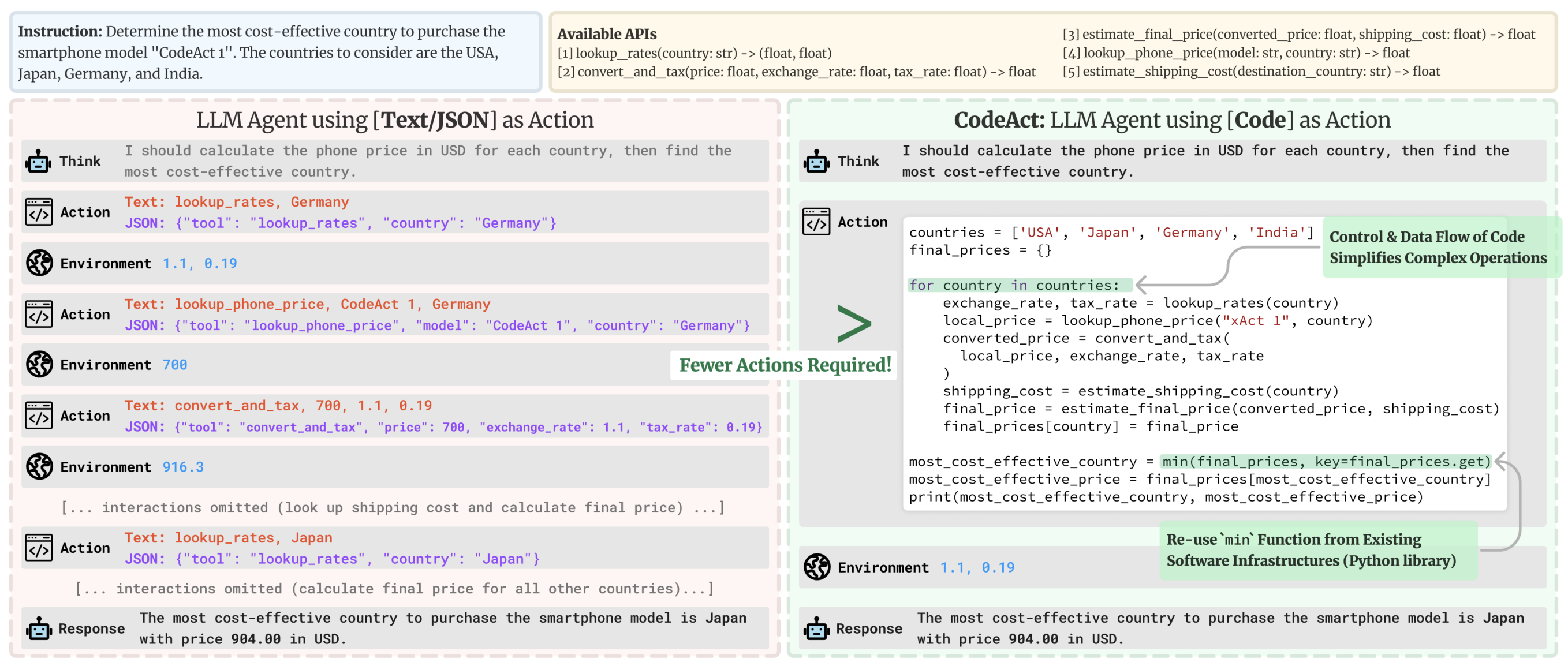
- Function-calling Agent: It is a subcategory of the JSON Agent which has been fine-tuned to generate a new message for each action
Type of Actions
- Information Gathering: Performing web searches, querying databases or retrieving documents
- Tool Usage: Making API calls, running calculations and executing codes
- Environment Interaction: Manipulating digital interfaces or controlling phuysical devices
- Communication: Engaging with users via chat or collaborating with other agents
Type of Observation
- System Feedback
- Data Changes
- Environmental Data
- Response Analysis
- Time-based Events